Environmental and Larval Indices as Predictors of Dengue Hemorrhagic Fever: A Five-Year Spatial Study in Surabaya, Indonesia

Downloads
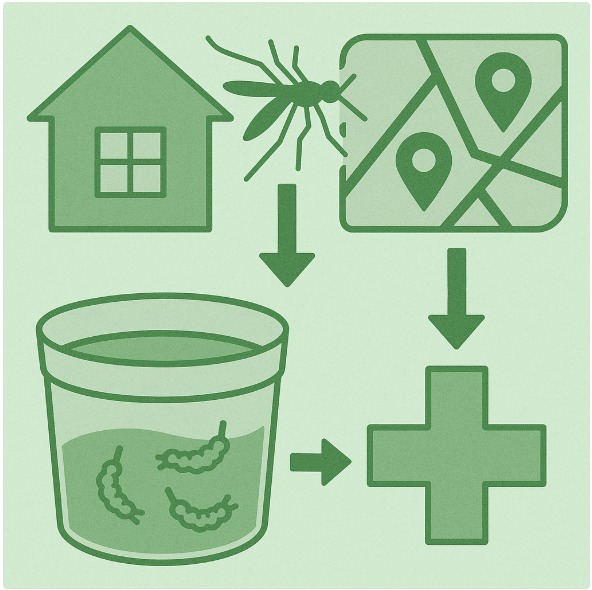
Dengue Hemorrhagic Fever cases are one of the public health problems that are endemic in the Sememi Health Center working area. This study analyzes the relationship between environmental factors that influence dengue fever cases, including the larval index, rainfall, temperature, and humidity in the working area of the Sememi Community Health Center, which recorded 183 cases from 2020 to 2024.This study utilized a cross-sectional analytical design, with analysis conducted on 60 monthly secondary data collected over five years. The correlation test results show that only the number of free larvae has a significant relationship with cases of dengue fever (Sig.= 0.000), while other climate factors do not. These findings confirm the crucial role of the number of free larvae as a determining indicator of dengue fever cases. The main limitation of this study is the aggregate and secondary nature of the data, which does not allow for confirmation of cause and effect, but only correlation. Based on these findings, it is recommended that the Mosquito Nest Eradication program be strengthened as a top priority in efforts to control dengue fever.
Copyright (c) 2025 Jeny Elsa Oktavia, Suprijandani, Demes Nurmayanti, Marlik, Setiawan

This work is licensed under a Creative Commons Attribution 4.0 International License.